


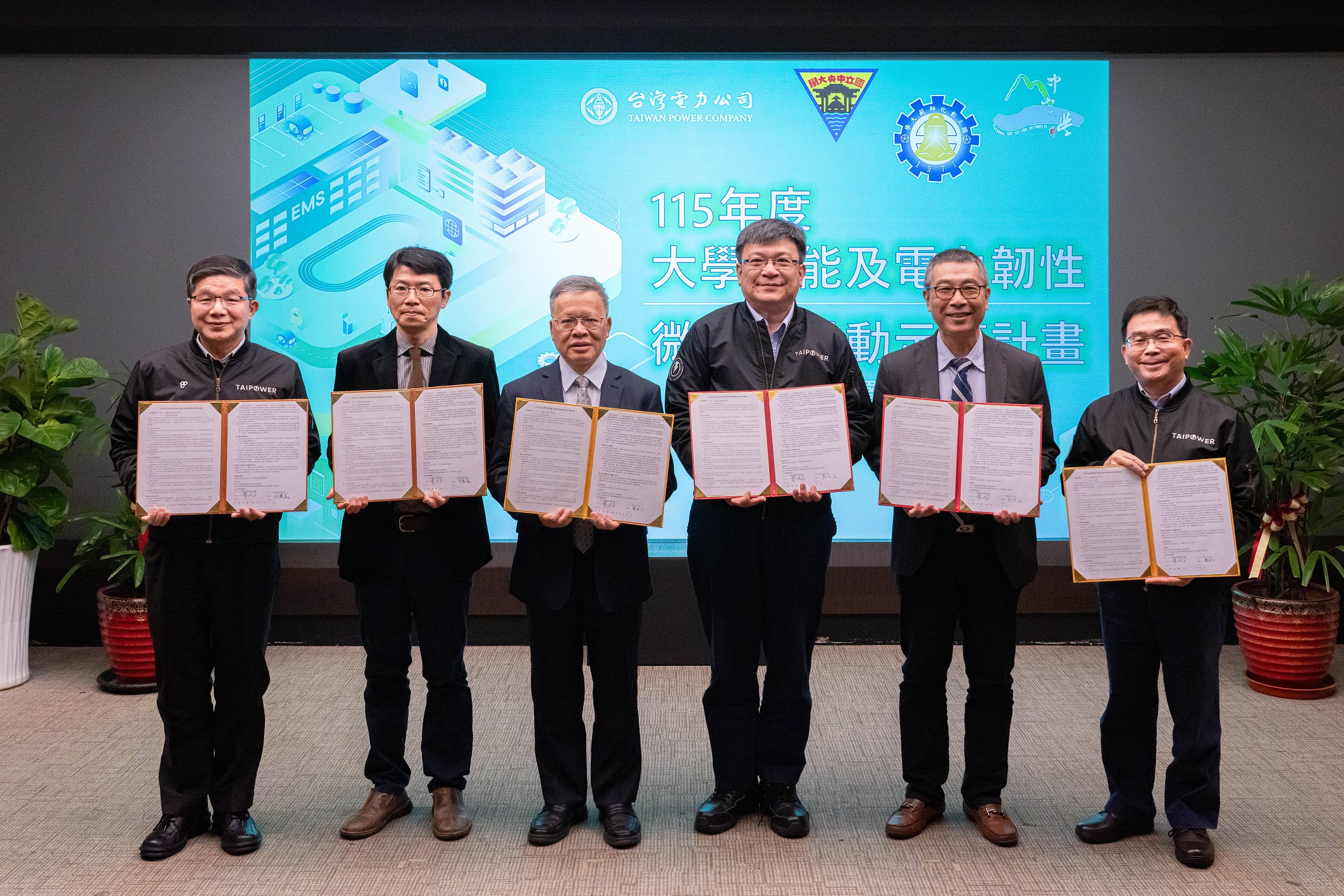
March 13, 2026-Taipower has been actively promoting university microgrid demonstration projects, aiming to achieve innovations in energy technology, expand the practical application of microgrids, and cultivate talent. Today, Taipower signed a memorandum of understanding (MOU) with National Central University (NCU), National Changhua University of Education (NCUE), and National Sun Yat-sen University (NSYSU), with installation of the university microgrid systems slated for 2027. A Taipower representative expressed that this project will leverage the schools' research capacity and Taipower's practical experience in electrical systems to promote micro grid technology demonstrations and applications. Additionally, both sides will comprehensively plan energy and sustainability curricula to jointly cultivate professional talent for the power industry.
On March 13, Taipower held an MOU signing ceremony at Taipower Building for the 2026 University Energy Conservation and Electrical Resilience-Microgrid Promotion Demonstration Plan. Taipower Chairman Tseng Wen-Sheng, NCU President Hsiau Shu-San, NCUE Director of General Affairs Liu Chin-Chia, and NSYSU Senior Vice President Kuo Chih-Wen were on site to jointly sign the agreement.
A Taipower representative indicated that Taiwan has been rapidly developing green energy and distributed energy resources in response to the global push for net-zero emissions. Taipower continuously invests in energy system upgrades. In recent years, in addition to accelerating the replacement of outdated equipment and integrating smart facilities, the Company has been building a more robust energy grid through the promotion of energy storage and microgrid projects.
Microgrids are small-scale grid systems with integrated electricity generation, storage, and management. They can operate independently or be linked to the Taipower grid, assisting with diverse applications such as energy conservation, regional independent energy supply, and disaster proofing. When campuses establish microgrid systems, it is equivalent to adding a self-sufficient power node. At times of need, e.g., during typhoons and other emergency situations, the system can autonomously power the campus, or it can instantly provide aid by contributing self-generated electricity to the Taipower grid.
Taipower is actively promoting university microgrid demonstration projects in hopes of increasing expertise, technology, and talent cultivation for microgrid applications. All Taiwanese institutes of higher education with Electrical Engineering departments are invited to participate. Following a comprehensive assessment of site plans, microgrid management and operation plans, and energy saving results plans by a joint review committee comprising professional units from Taipower; the Public Construction Commission, Executive Yuan; the Ministry of Education; the Energy Administration, Ministry of Economic Affairs; and relevant domestic research institutions, Taipower is now building on its 2024 collaboration with National Taiwan University of Science and Technology, National Chung Hsing University, and National Chung Cheng University by collaborating with NCU, NCUE, and NYSYU to jointly promote the construction of campus microgrids.
The NCU project will construct a "clustered" microgrid framework, creating several small-scale campus microgrids that can operate independently or mutually support each other, further elevating power resilience. The NCUE project will install a campus microgrid system with multiple microgrids along the same powerline, aiming to validate the configuration's effectiveness and ensure a flexible connection with the grid. The NSYSU project will install a microgrid that transforms the Building of International Research into a disaster shelter that can autonomously supply electricity for over 48 hours. Additionally, because this campus is located at the end of the feeder line, data on its grid operations will serve as an important reference when designing electrical systems for remote islands and mountainous regions.
In the short term, the university microgrid demonstration project will treat six universities, including NCU, NCUE, and NSYSU, as testing grounds for power source technology verification and innovation. In addition to providing opportunities for teachers and students to directly participate in the research and practical application of power technology, the project will facilitate courses related to energy and environmental knowledge, microgrid energy management technology, and the United Nations Sustainable Development Goals (SDGs) to cultivate professional talents in the electric power field, promote the long-term development of Taiwan’s power systems, and advance distributed energy technology.
Spokesperson: Chief Administrator Huang Mei-Lien
Phone: (02) 2366-6271; 0922-696-383
E-mail: u030573@taipower.com.twContact Person: Department of Power Distribution Director Jao Yu-Chen
Phone: (02) 2366-8669; 0939-890-208
E-mail: u149005@taipower.com.tw